Dropshipping vs holding inventory: which is right for your Shopify store?
Key takeaways
- Dropshipping means a supplier ships each order straight to your customer, so you need little money upfront but earn less per sale and control less.
- Holding inventory means you buy stock in bulk and ship it yourself or through a warehouse, so you earn more per sale and control quality and delivery, but you risk unsold stock.
- In our example numbers, holding stock only beats dropshipping on cash once you sell about 148 of 200 units, which is why stock suits proven products.
- A common path is hybrid: test products by dropshipping, then hold stock of the few that sell steadily.
- Watch the main risk of each model: supplier price and stock changes in dropshipping, overstock and dead stock when you hold inventory.
Dropshipping vs inventory comes down to who holds the stock. With dropshipping, a supplier keeps the products and ships each order directly to your customer. When you hold inventory, you buy products in advance, store them and ship them yourself. Dropshipping costs less to start and is less risky; holding stock usually earns more per sale and gives you more control. This guide compares the two side by side, works through the profit on the same product under both models, and shows how Shopify handles each.
What is the difference between dropshipping and holding inventory?
The difference is when you pay for the product and who ships it. A dropshipper pays the supplier only after a customer has paid, and the supplier ships. A store that holds inventory pays for stock before anyone orders, then ships from its own shelves or a warehouse.
- Dropshipping: you list a supplier's products in your store. When an order comes in, you buy that one unit from the supplier, who sends it to your customer. You never touch the product. Our guide on how to start dropshipping on Shopify covers the setup.
- Holding inventory (wholesale): you buy products in bulk, usually at a lower price per unit called the wholesale price, and keep them in stock. You or a fulfillment company pick, pack and ship each order. "Dropshipping vs wholesale" is the same question in other words.
- Print-on-demand: a type of dropshipping where the supplier prints your design on a blank product, such as a T-shirt or mug, after the customer orders it. You hold no stock, but the product carries your own design.
- Hybrid: you hold stock of some products and dropship others from the same store.
Dropshipping vs inventory: how do they compare side by side?
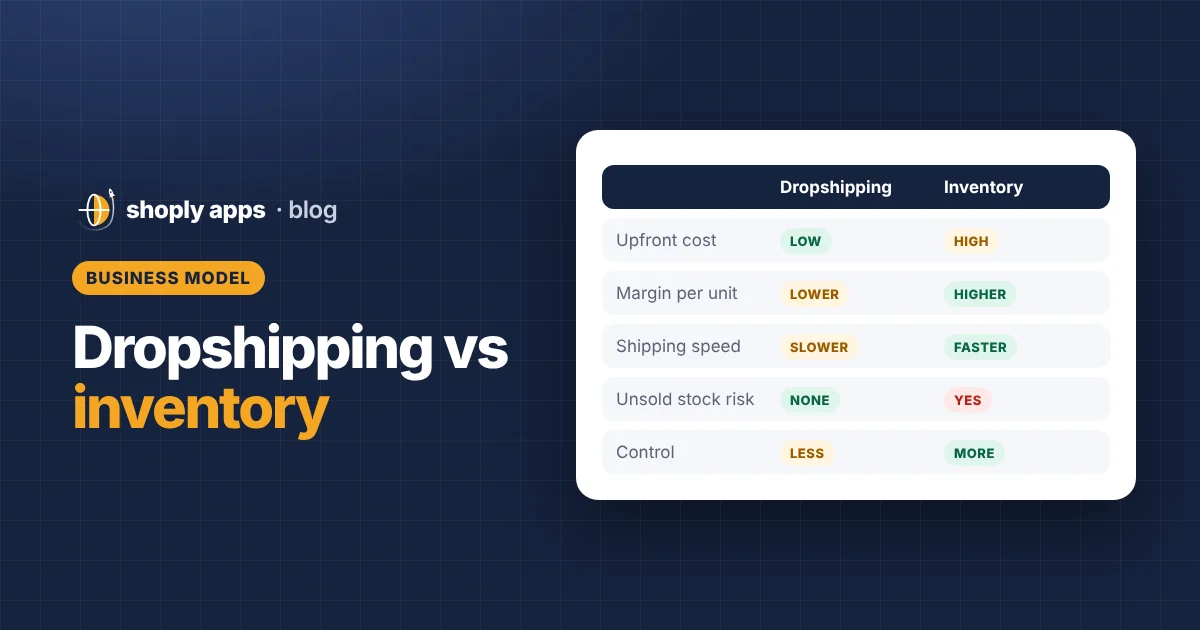
Dropshipping wins on low cost and low risk; holding inventory wins on margin, control and speed. The table below sums up the trade-offs.
| Factor | Dropshipping | Holding inventory |
|---|---|---|
| Upfront cost | Low. You pay for each unit after the customer pays you. | Higher. You pay for a bulk order before you sell anything. |
| Margin per unit | Lower. Single-unit prices plus supplier shipping. | Higher. Bulk unit prices are usually lower. |
| Control over quality | Limited. You rely on the supplier's checks. | High. You can inspect stock before it ships. |
| Shipping and packaging | Set by the supplier; often plain packaging. | Your choice of carrier, packaging and inserts. |
| Shipping speed | Depends on the supplier; can be slow if they ship from far away. | Usually faster when stock is close to your customers. |
| Cash flow and unsold stock | No unsold stock to pay for. | Cash is tied up in stock; unsold units can become a loss. |
| Workload | Less physical work; more supplier follow-up and customer service on delays. | Storing, packing and shipping, or paying someone to do it. |
| Scaling | Easy to add products; margin stays thin as you grow. | Needs more cash and space; better unit costs at higher volume. |
| Branding | Harder; other stores may sell the same product. | Easier to use your own packaging, labels or private-label products. |
Which makes more profit: dropshipping or buying in bulk?
Buying in bulk makes more profit per unit, but only beats dropshipping overall once you sell enough units to cover the money you paid upfront. Here is the same product under both models. All numbers are made-up examples; use your own supplier quotes.
The product is a phone stand that sells for $30. The payment fee is an example of 3% + $0.30, or $1.20 per order; check your own rate on Shopify's current pricing page and with your payment provider.
| Cost per order (example) | Dropshipping | Holding inventory |
|---|---|---|
| Product cost per unit | $11.00 | $6.00 (bulk order of 200) |
| Freight to you, per unit | — | $1.00 |
| Storage and packing, per unit | — | $1.00 |
| Packaging | — | $0.50 |
| Shipping to the customer | $5.00 (supplier) | $5.00 (your label) |
| Payment fee | $1.20 | $1.20 |
| Total cost per sale | $17.20 | $14.70 |
| Profit per sale | $12.80 (42.7% margin) | $15.30 (51% margin) |
Per sale, holding stock looks clearly better. But the stock model needs $1,400 upfront: 200 units at $6 plus $200 of freight. Compare the cash you end up with:
- You sell all 200: dropshipping earns 200 × $12.80 = $2,560. Holding stock earns 200 × $22.30 (price minus storage, packaging, shipping and fee) = $4,460, minus the $1,400 upfront = $3,060.
- You sell only 120: dropshipping earns 120 × $12.80 = $1,536. Holding stock earns 120 × $22.30 = $2,676, minus $1,400 = $1,276, and you still have 80 units on the shelf that you may have to discount.
The break-even point, where both models leave you with the same cash, is easy to find:
Break-even units = Upfront stock cost ÷ (Cash per sale with stock − Profit per sale dropshipping)
= $1,400 ÷ ($22.30 − $12.80) = $1,400 ÷ $9.50 ≈ 148 units
So in this example, buying stock only pays off if you are confident of selling more than about 148 of the 200 units. That is why most sellers hold stock of proven products, not new ones. For more on pricing dropshipped products, read our guide to dropshipping profit margins.
Should I dropship or hold stock?
Dropship if you are testing ideas or have little money to spend; hold stock if you have products that already sell and want better margins and control. A simple way to decide:
Dropshipping suits you if
- You are new and want to test products without risking much cash.
- You want a wide range of products and cannot predict which will sell.
- You do not have space to store stock or time to pack orders.
- Your customers accept longer delivery times for the product type.
Holding inventory suits you if
- You have a product that sells steadily and you can estimate monthly sales.
- You can afford a bulk order without needing that cash for anything else.
- Fast shipping, quality checks or branded packaging matter to your customers.
- You want to build a brand rather than sell the same items as many other stores.
What is the hybrid model, and how do you switch?
The hybrid model means you dropship most products and hold stock only of your best sellers. It lets you keep testing cheaply while earning better margins on the products that have proved themselves.
- Test by dropshipping. List new products without buying stock. Pick products with a clear audience and a price that leaves room for margin.
- Find the steady sellers. Look for products that sell week after week, not one lucky spike.
- Get bulk quotes. Ask your supplier or a wholesaler for a per-unit price at a quantity you can afford, plus freight costs.
- Run the break-even sum. Use the formula above. If you would need to sell more than you expect in a few months, order less or wait.
- Start small. Order a modest first batch, check quality, and reorder based on real sales.
How does Shopify handle dropshipping and inventory?
Shopify supports both models in the same store; the difference is mostly in each variant's inventory settings. Settings and names can change, so check Shopify's help center for the current steps.
- Track quantity: for products you hold, turn on inventory tracking so Shopify counts stock down as orders come in. For dropshipped products, sellers often leave tracking off or let a supplier app sync stock levels, depending on how their supplier works.
- Continue selling when out of stock: this option lets customers keep ordering a tracked variant at zero stock. It can make sense for pre-orders, but if you leave it on by accident you can take orders you cannot fill. See out of stock and oversold on Shopify for how to avoid that.
- Locations: Shopify lets you add locations, such as your home, a shop or a warehouse, and track stock separately at each. Your plan sets how many you can have.
- Cost per item: enter what you pay for each variant, including your landed cost per unit for stock you hold, so Shopify can show profit and margin.
What risks should you watch in each model?
In dropshipping the biggest risk is that your supplier changes price or runs out without you noticing; with stock, it is buying more than you can sell.
Dropshipping risks
- Supplier price rises. If the supplier raises the price and you do not update your cost and price, you can end up selling below cost on every order.
- Supplier stock-outs. If stock is not synced, customers can order something the supplier no longer has.
- Slow or lost deliveries. Customers blame your store, not the supplier, so expect refunds and support work.
Holding inventory risks
- Overstock and dead stock. Dead stock is inventory that has stopped selling. It ties up cash and space and may have to be sold at a discount or written off.
- Running out. Bulk orders take time to arrive, so a best seller can sell out before the next batch lands.
- Damage and storage costs. Stock can be damaged or go out of date, and storage costs money every month.
Both sets of risks are easy to miss in a growing catalog. Shoply: Item Scan & Analytics, free on the Shopify App Store, scans every product for problems such as selling below cost, missing cost per item, taking orders with no stock, low stock, items that will sell out soon and products not selling in 60 days, so you can catch them early.
FAQ
Is dropshipping or holding inventory more profitable?
Holding inventory usually earns more per sale because buying in bulk lowers the unit cost, but you pay for stock upfront and risk being left with units you cannot sell. Dropshipping earns less per sale with far less risk. Which makes more money overall depends on how many units you actually sell.
Can I dropship and hold inventory in the same Shopify store?
Yes. Many stores keep their best sellers in stock and dropship the rest. In Shopify you can track inventory on the products you hold and set up the dropshipped products according to how your supplier or supplier app syncs stock.
Is print-on-demand the same as dropshipping?
Print-on-demand is a type of dropshipping. A supplier prints your design on a product such as a T-shirt or mug only after a customer orders it, then ships it directly to the customer, so you hold no stock.
When should I switch from dropshipping to holding stock?
Consider it when a product sells steadily, you know roughly how many units you sell each month, the bulk price is clearly lower, and you can afford the upfront order without risking money you need elsewhere. Start with a small first order.
Catch supplier price changes and dead stock early
Whether you dropship, hold stock or both, Shoply: Item Scan & Analytics, free on the Shopify App Store, flags products sold below cost, low or oversold stock and items that have stopped selling, ranked by the money at stake each month.
Install free on Shopify