Dropshipping profit margins: how to price products so you actually make money
Key takeaways
- A dropshipping profit margin is the share of the selling price you keep as profit; gross margin only subtracts product and supplier shipping costs, while net margin also subtracts fees, apps, refunds and ad costs.
- Price from your full cost per order, not from the product cost alone: rules like “2x–3x the product cost” can still lose money once the ad cost of winning each order is included.
- Your maximum ad cost per order is your profit before ads, and break-even ROAS = price ÷ profit per order before ads.
- To hit a target margin, use price = total cost ÷ (1 − target margin), then round to a sensible price and recheck.
- Enter cost per item in Shopify and review margins regularly, because supplier prices, shipping and ad costs change.
A dropshipping profit margin is the percentage of each sale you keep as profit after paying for everything that went into that order. In dropshipping the product is often cheap, but the costs around it are not: supplier shipping, payment fees, apps, refunds and, above all, advertising. This guide walks through every cost per order, shows a worked example, and gives you formulas to set prices that actually leave money in your pocket.
What is a dropshipping profit margin?
A dropshipping profit margin is profit divided by the selling price, shown as a percentage. If a customer pays $30 and you keep $6 after all costs, your margin is 20%.
Margin = (Price − Costs) ÷ Price
Margin is not the same as markup. Markup divides profit by cost instead of by price, so a 100% markup (doubling the cost) is only a 50% margin. When you compare numbers, make sure you know which one you are looking at. If you are new to selling this way, our guide on how to start dropshipping on Shopify covers the setup side.
What is the difference between gross and net margin?
Gross margin only subtracts what the goods cost you to deliver; net margin subtracts every cost of the order. Both are useful, but only net margin tells you whether you made money.
- Gross margin = (price − product cost − supplier shipping) ÷ price. This is roughly what you see when you compare your price with your supplier's price.
- Net margin = (price − all costs per order) ÷ price, including payment fees, app subscriptions, refunds, currency conversion and the ad cost to win the order.
Many new store owners see a healthy gross margin and assume they are profitable. In dropshipping, the gap between gross and net is usually large, mainly because of advertising.
What costs go into each dropshipping order?
Every order carries a stack of costs, not just the product price. Here is the full list to account for:
- Product cost: what the supplier charges for one unit.
- Supplier shipping: what the supplier charges to send it to your customer, even if the customer pays nothing for shipping.
- Payment processing fees: usually a percentage of the order plus a small fixed amount. Check your own rate in your Shopify admin and on Shopify's current pricing page, as it depends on your plan, country and payment provider.
- App subscriptions: monthly app and plan costs, spread across your orders (monthly cost ÷ orders per month).
- Ad cost per acquisition (CPA): what you spend on ads, on average, to get one order.
- Returns and refunds: money lost when orders are refunded or reshipped. Set aside an allowance per order.
- Currency conversion: if you pay your supplier or receive payouts in a different currency, conversion fees and exchange rates take a cut.
Worked example: one product from price to net profit
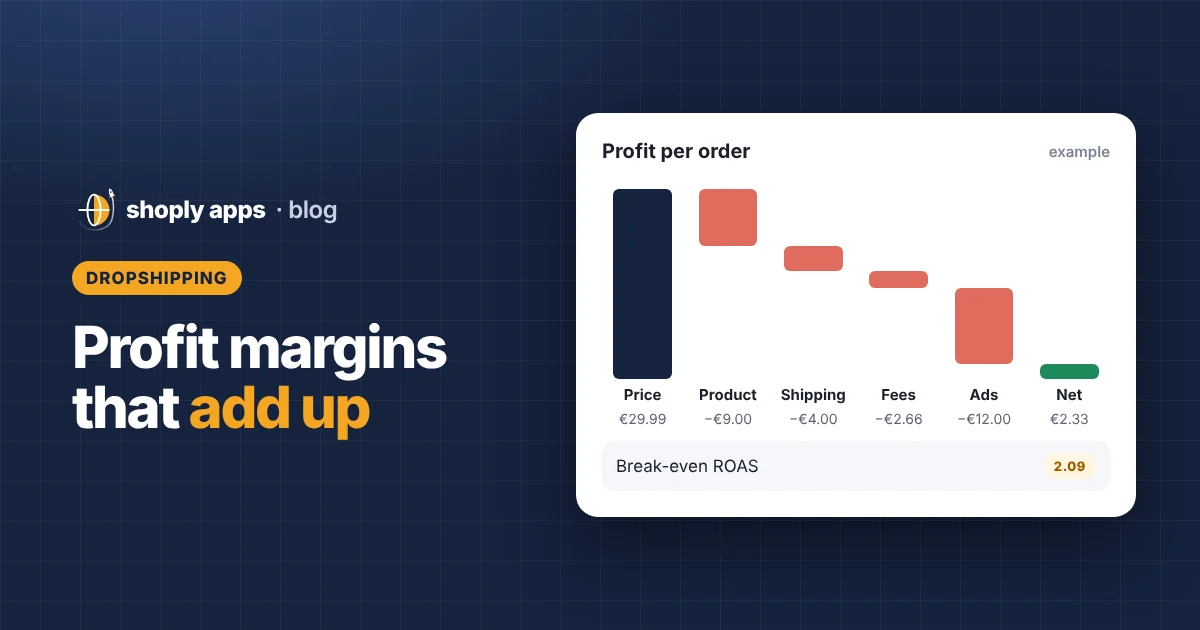
The table below follows one product, a desk lamp, from the price the customer pays down to the profit you keep. All numbers are example numbers chosen to show the method; use your own supplier quotes, fee rates and ad results.
| Line (example numbers) | Amount | Running total |
|---|---|---|
| Price the customer pays | $29.99 | $29.99 |
| Product cost | −$9.00 | $20.99 |
| Supplier shipping | −$4.00 | $16.99 |
| Gross profit (gross margin 56.7%) | $16.99 | |
| Payment fee (example: 3% + $0.30) | −$1.20 | $15.79 |
| Currency conversion (example: 2% of the $13 paid to the supplier) | −$0.26 | $15.53 |
| Apps (example: $60 a month ÷ 200 orders) | −$0.30 | $15.23 |
| Refund allowance (example: 3% of price) | −$0.90 | $14.33 |
| Profit before ads | $14.33 | |
| Ad cost per order (example CPA) | −$12.00 | $2.33 |
| Net profit (net margin 7.8%) | $2.33 |
A product with a 56.7% gross margin ends up with a 7.8% net margin. That is still a profit, but a small rise in ad costs or refunds would wipe it out.
Why can the "2x–3x the product cost" rule still lose money?
Because it only looks at the product cost and ignores everything else, especially ads. A multiplier says nothing about what it costs to win the order.
Take the same lamp and price it at 2.5 times the $9 product cost, rounded to $22.99. Using the same example costs, the fees and refund allowance shrink slightly with the lower price, leaving about $7.75 of profit before ads. With the same $12 ad cost per order, every sale loses about $4.25. The rule of thumb looked safe, yet the more you sell, the more you lose.
Multipliers can be a starting point for a quick check, but treat them as rough rules of thumb, not a pricing method. The products that work best usually have room for a price well above their full cost; our guide on how to find winning dropshipping products explains how to check that before you commit.
How much can you afford to spend on ads per order?
Your maximum ad cost per order is your profit before ads. Spend more than that to win an order and you lose money on it; spend less and the difference is your profit.
Break-even CPA = Price − all costs except ads
Break-even ROAS = Price ÷ Break-even CPA
ROAS (return on ad spend) is sales from ads divided by ad spend. In the example, profit before ads is $14.33, so:
- Break-even CPA = $14.33. Any ad cost per order above this is a loss.
- Break-even ROAS = $29.99 ÷ $14.33 ≈ 2.09. Each $1 of ads must bring in at least about $2.09 in sales.
- If you want $5 net profit per order, your maximum CPA is $14.33 − $5 = $9.33, and your target ROAS is $29.99 ÷ $9.33 ≈ 3.21.
If customers often buy more than one item, use your average order value and average costs per order instead of a single product's numbers. Ad platforms report ROAS in their own way, so compare it with the orders and revenue in your Shopify admin too. Improving how many visitors buy also lowers your cost per order; see practical fixes to increase your Shopify conversion rate.
How do you price dropshipping products?
Start from your full cost per order and the margin you want, then check the result against what customers will pay. A good dropshipping pricing strategy uses a few methods together.
Cost-plus to a target margin
Add up your total cost per order, including your expected ad cost, and divide by what is left after your target margin.
Price = Total cost ÷ (1 − Target margin)
For example, if one order costs you $25 in total and you want a 20% net margin, the price is $25 ÷ 0.80 = $31.25.
Some costs, like payment fees and refunds, rise with the price. To include them, subtract them as a percentage in the formula: price = fixed costs ÷ (1 − target margin − percentage costs). For the lamp, the fixed costs are $9 + $4 + $0.30 fixed fee + $0.26 conversion + $0.30 apps + $12 ads = $25.86, and the percentage costs are 3% fees + 3% refunds. For a 15% net margin: $25.86 ÷ (1 − 0.15 − 0.06) = $25.86 ÷ 0.79 ≈ $32.73. Round to $32.99, and the net profit per order comes to about $5.15, a margin of about 15.6%.
Value and competitor-based pricing
Look at what similar products sell for and what makes yours worth more or less: better photos, faster delivery, a clearer description or a guarantee. If the market price is below what your costs allow, change the product, the supplier or the offer rather than accepting a loss.
Charm pricing
Charm pricing means ending prices just below a round number, such as $32.99 instead of $33. Many stores use it; whether it helps your store is something to test. Always round up from your formula, never down below your target.
Free shipping built into the price
Your supplier still charges you for shipping when you offer free shipping, so add it to the product price. Selling the lamp at $25.99 plus $4 shipping, or at $29.99 with free shipping, costs the customer the same; the second option just shows one simple number.
Bundles to raise order value
Bundles spread the ad cost over more items. In our example, a two-lamp bundle at $54.99 with $18 product cost and an example $5 combined shipping leaves about $15.63 net profit, a 28.4% margin, if the ad cost per order stays at $12. Real ad costs for a bundle may differ, so test it.
How do you keep dropshipping margins healthy over time?
Treat pricing as a regular check, not a one-off decision. Costs move, and a price that was profitable last month can quietly become a loss.
- Watch supplier prices. Product and shipping costs can change without much notice. Update your numbers as soon as they do.
- Enter cost per item in Shopify. Put the product cost for every variant in the cost per item field so Shopify can show profit and margin. Some sellers include supplier shipping in this figure; whichever you choose, be consistent.
- Track your real ad cost per order. Recalculate break-even CPA when prices or costs change, and pause ads that run above it.
- Review margins on a schedule. Once a month, look for products priced below cost, at cost, or under your target margin. Our guide on finding Shopify products you're selling below cost shows how to do this with a CSV export.
- Check discounts. Work out the margin at the discounted price before you run a sale.
This is the kind of check Shoply: Item Scan & Analytics, free on the Shopify App Store, is built for: it flags products sold below cost, below your margin target or missing a cost per item, and lets you raise prices to a target margin in bulk with a preview.
FAQ
What is a good profit margin for dropshipping?
There is no single right number, because it depends on your ad costs, product and price point. As a rough rule of thumb, aim for a net margin you can live with after ads, fees and refunds, and make sure the margin before ads is at least large enough to cover the ad cost of winning each order.
Is the 2x or 3x product cost rule enough to price dropshipping products?
Not on its own. A multiple of the product cost ignores supplier shipping, payment fees, refunds, app costs and, most importantly, the ad cost per order. Work out your full cost per order first, then set a price that leaves the margin you want.
How do I calculate break-even ROAS for dropshipping?
Break-even ROAS = price ÷ profit per order before ads. If a product sells for $29.99 and leaves $14.33 before ads, break-even ROAS is about 2.09, which means each $1 of ad spend must bring in at least $2.09 in sales.
Should I offer free shipping on dropshipping products?
You can, but the supplier still charges you for shipping, so build that cost into the product price. Check the margin at the new price and compare the total the customer pays with similar stores before you decide.
Know your margin on every product
Shoply: Item Scan & Analytics, free on the Shopify App Store, scans every product for pricing and margin problems, from products sold below cost to missing cost per item, and ranks them by how much money is at stake each month.
Install free on Shopify