How to find winning dropshipping products without guessing
Key takeaways
- A winning dropshipping product solves a clear problem or has strong appeal, keeps a healthy margin after every cost, is hard to find in local shops, and ships well with few returns.
- Find ideas in marketplace best-seller lists, search trend tools such as Google Trends, social media, customer reviews and complaints, and niches you already know.
- Score each idea on the same weighted scorecard so you compare products on facts instead of gut feeling.
- Before scaling, order a sample, check the supplier and delivery times, test with a small budget, and set a kill rule in advance.
- After launch, track sales and margin per product and remove products that do not sell.
Finding winning dropshipping products is less about luck and more about a repeatable process: collect ideas, score them against the same criteria, test the best few cheaply, and keep only what earns money. Dropshipping means you sell products that a supplier stores and ships straight to your customer, so you never hold stock yourself. Anyone can list the same item, so choosing well matters.
What makes a dropshipping product "winning"?
A winning product is one that sells steadily and leaves you a real profit after every cost, not just one that looks popular. In practice, most good dropshipping products share these traits:
- It solves a clear problem or has strong appeal. People understand in seconds why they would want it: it fixes an annoyance, saves time, or is simply delightful for a specific group of people.
- It has a healthy margin after all costs. Margin is profit as a share of the selling price. "After all costs" means after the supplier price, shipping, payment fees, advertising and an allowance for refunds.
- It is hard to find in local shops. If shoppers can pick it up at the supermarket today, few will wait one or two weeks for delivery.
- It ships well. Light, compact and not fragile, so shipping is cheap and items arrive intact.
- It has low return risk. Few sizes or variants, simple to use, and easy to describe accurately, so it matches what customers expected.
"Trending" is not on the list: a trending product with a thin margin or high breakage is still a poor choice.
How do you find products to dropship?
Look where demand is already visible, then filter the ideas with the scorecard below. Good sources of product ideas include:
- Marketplace best-seller lists. Large marketplaces publish best-seller and "most wished for" lists by category. Supplier sites such as AliExpress often show how many orders a listing has had. They show what people already buy.
- Search trend tools. Google Trends shows whether interest in a search term is rising, falling, steady or seasonal. A product with steady or slowly rising interest is usually safer than a sudden spike that may fade.
- Social media. Short videos and posts on platforms such as TikTok, Instagram and Pinterest show which products make people stop scrolling and comment "where do I get this?". Read the comments, not just the view counts.
- Customer reviews and complaints. One- to three-star reviews of existing products are a list of unmet needs. If buyers keep saying "it broke after a week" or "wish it came with a case", there may be room for a better version or a smarter bundle.
- Your own niche knowledge. If you fish, garden, keep reptiles or work as a nurse, you know the small frustrations and the products insiders actually use.
Write every idea into one spreadsheet; the next step decides which ones deserve a test.
How do you score dropshipping product ideas?
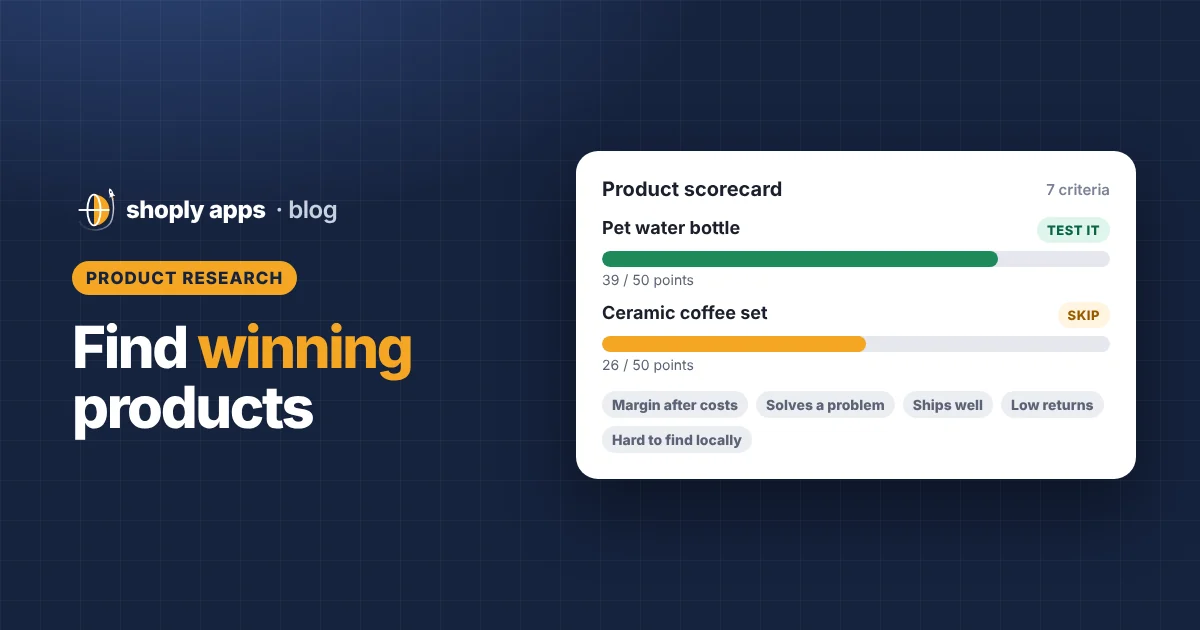
Give each idea a score from 1 (poor) to 5 (excellent) on each criterion, multiply by the weight, and add up the results. With the weights below, the maximum is 50. A scorecard turns dropshipping product research into a consistent comparison instead of a hunch. The weights are a suggested starting point; adjust them to your store.
| Criterion | Weight | How to score (1 = poor, 5 = excellent) |
|---|---|---|
| Problem solved or appeal | 2 | 5 if the benefit is obvious in one sentence or one short video; 1 if you have to explain why anyone needs it |
| Margin after all costs | 2 | 5 if roughly 30% or more is left after product, shipping, fees and ads; 1 if under about 10% |
| Visible demand | 2 | 5 for steady or rising search interest and real buyer comments; 1 for no signs anyone is looking |
| Hard to find locally | 1 | 5 if not sold in ordinary local shops; 1 if every supermarket stocks it |
| Ships well | 1 | 5 for light, small and sturdy; 1 for heavy, bulky or fragile |
| Low return risk | 1 | 5 for one size and simple use; 1 for many sizes or a high chance of "not as expected" |
| Supplier reliability | 1 | 5 for a responsive supplier with clear delivery times and good reviews; 1 for slow replies or vague shipping |
The margin thresholds above are examples, not rules. For a full walk-through of pricing, see our guide to dropshipping profit margins.
Worked example: two products scored side by side
All numbers here are made-up examples to show the method. Imagine you are choosing between a portable pet water bottle and a ceramic pour-over coffee set. First, the margin after all costs per order. The payment fee uses an example of 3% + $0.30, and the ad cost is your estimated advertising spend per sale; check your own rates.
| Per order | Pet water bottle | Ceramic coffee set |
|---|---|---|
| Selling price | $24.99 | $49.99 |
| Supplier price | −$6.00 | −$18.00 |
| Shipping you pay | −$3.00 | −$9.00 |
| Payment fee (example) | −$1.05 | −$1.80 |
| Ad cost per sale (estimate) | −$8.00 | −$12.00 |
| Profit | $6.94 | $9.19 |
| Margin | 27.8% | 18.4% |
Margin = Profit ÷ Selling price
Pet bottle: $6.94 ÷ $24.99 = 27.8%
Coffee set: $9.19 ÷ $49.99 = 18.4%
The coffee set makes more dollars per order, but a smaller share of the price, and that is before any breakage. Now the full scorecard:
| Criterion (weight) | Pet water bottle | Ceramic coffee set |
|---|---|---|
| Problem or appeal (×2) | 4 → 8 | 4 → 8 |
| Margin after all costs (×2) | 4 → 8 | 2 → 4 |
| Visible demand (×2) | 3 → 6 | 3 → 6 |
| Hard to find locally (×1) | 3 → 3 | 2 → 2 |
| Ships well (×1) | 5 → 5 | 1 → 1 |
| Low return risk (×1) | 5 → 5 | 2 → 2 |
| Supplier reliability (×1) | 4 → 4 | 3 → 3 |
| Total (out of 50) | 39 | 26 |
Both products are appealing, but the pet bottle wins clearly because it is light, sturdy and keeps more of each sale. Long-distance shipping and fragile ceramics often mean breakages and refunds. Pick a cut-off score that you test from, for example 35 out of 50, and stay consistent.
How do you test a product before spending real money?
Validate a product with a small, planned test before you scale: check the item and supplier yourself, then spend a fixed budget and judge the result against a rule you set in advance. A simple sequence:
- Order a sample. See the real quality, packaging and delivery time your customer will get. Take your own photos and short videos while you have it in hand.
- Check supplier reliability. Message the supplier with a question and note how fast and how clearly they reply. Read their reviews, confirm delivery times to the countries you sell to, and ask what happens with lost or damaged parcels.
- Build one good product page. Clear title, honest description, real photos and an accurate delivery estimate.
- Set a small test budget. Decide how much you are willing to spend on ads for this one product, and do not top it up mid-test because of a hunch.
- Define a kill rule before you start. A kill rule is the point at which you stop a test, written down before emotions get involved.
Here is an example kill rule using the pet bottle above. Before ads, each sale leaves $24.99 − $6.00 − $3.00 − $1.05 = $14.94. That is your break-even ad cost per sale: spend more than that to win one order and you lose money on it. An example rule could be: "If I have spent $45 on ads (about three times break-even) and made no sale, stop. If I am getting sales but paying more than $14.94 in ads for each one, fix the page or the ad once, then stop if it does not improve." Your own numbers will differ; the point is to decide them in advance.
If you are still setting up your store, our step-by-step guide to starting dropshipping on Shopify covers the basics before you test.
Which products should beginners avoid?
Avoid products that bring legal, safety or return problems you cannot control as a dropshipper. Common red flags:
- Trademarked or branded goods. Selling copies or unauthorised branded items can lead to takedowns, frozen payments or legal trouble. If a listing uses a famous brand's name or logo and is suspiciously cheap, walk away.
- Regulated products. Items such as supplements, cosmetics, medical-style devices or anything you would sell with health claims can be subject to specific rules in the countries you sell to. Check those rules, or skip the category while you are starting out.
- Sizing-heavy apparel and shoes. Many sizes mean many variants, more "does not fit" returns, and supplier size charts that often do not match.
- Fragile items. Glass, ceramics and anything delicate are more likely to break over long shipping distances, and each breakage is a refund plus an unhappy customer.
- Products that need safety certification. Children's toys, electrical items and anything with batteries or chargers may need specific safety marks or testing to be sold legally in some markets. Ask the supplier for proof and check what your market requires.
When in doubt, choose something simpler.
What should you do after a product goes live?
Track each product's sales and real margin, and remove the ones that do not earn their place. Finding winning dropshipping products is an ongoing loop, not a one-time search.
- Enter cost per item for every variant in Shopify so you can see margin per product. If a supplier raises prices and you do not update it, a product can quietly slip toward a loss; our guide to finding products sold below cost shows how to spot that.
- Review sales and margin per product every week or two while testing, then at least monthly.
- Drop products that do not sell. Even without stock of your own, unsold listings clutter your store, dilute your collections and still need maintenance when suppliers change. It is the dropshipping version of dead stock: items that take up space and attention without making money.
- Watch supplier stock. If the supplier runs out and your listing stays live, you take orders you cannot fulfil.
A monthly routine makes this easier; our Shopify catalog health checklist covers margins, stock and content in one pass. We are also building Shoply: Item Scan & Analytics, free on the Shopify App Store, which flags products that have not sold in 60 days, are below your margin target or are missing a cost per item, and ranks them by money at stake each month.
FAQ
How many products should I test when I start dropshipping?
Start with a small number you can test properly, such as three to five products, each with its own budget and kill rule. Testing a few products well tells you more than listing hundreds and promoting none of them.
Is a product with lots of sellers already saturated?
Not always. Many sellers usually means real demand. The question is whether you can still earn a healthy margin and offer something different, such as a better bundle, clearer photos, faster shipping or a sharper niche. If the only way to compete is a lower price, skip it.
Should I order a sample before selling a dropshipping product?
Yes. A sample shows you the real quality, packaging and delivery time your customers will get, and gives you your own photos. It costs a little up front but can save you from refunds, complaints and chargebacks later.
When should I stop selling a dropshipping product?
Stop when it hits the kill rule you set before testing, when its margin after all costs stays too thin, or when it has not sold for a long stretch, for example 60 days. Removing dead products keeps your catalog focused on what actually sells.
Keep only the products that earn their place
Shoply: Item Scan & Analytics, free on the Shopify App Store, scans every product for margin, stock and content problems, including items that have stopped selling, so you can see which products to fix and which to drop.
Install free on Shopify