How to price your products: pricing strategies for Shopify stores
Key takeaways
- To price a product, start from its full cost per unit (product, inbound shipping, packaging, payment fees, shipping you pay and a returns allowance), not just what the supplier charges.
- Set prices with margin, not markup: price = cost ÷ (1 − target margin), so a €12 cost needs a €24 price for a 50% margin.
- Then adjust with a strategy that fits the product: competitor-based, value-based, premium, bundles and tiers, or charm pricing you test yourself.
- Discounts cost more than they look: at a 50% margin, a 20% discount needs about 67% more units sold just to earn the same profit.
- Review costs and margins every quarter, raise prices when costs rise, and keep variant prices in a logical order.
Knowing how to price products comes down to three steps: work out what one unit really costs you, choose the margin you need, and then adjust the price to fit your customers and competitors. Most new stores skip the first step and price from the supplier cost alone, which is how a product that looks profitable ends up losing money. This guide walks through each step with a worked example, the main pricing strategies for ecommerce, and a checklist you can reuse.
What should you include in the cost of a product?
Include every cost you pay to get one unit into a customer's hands, not just the purchase price. That total is the number every pricing decision starts from.
Here is an example for one product. The figures are made up for illustration; use your own.
| Cost item | Example per unit |
|---|---|
| Product cost from the supplier | €8.00 |
| Inbound shipping and packaging | €1.20 |
| Payment fees (estimate; depends on your plan and provider) | €0.90 |
| Outbound shipping you pay (for example, free shipping) | €1.40 |
| Returns allowance (an average set aside per unit) | €0.50 |
| Full cost per unit | €12.00 |
Enter this figure, or at least the product, inbound shipping and packaging part of it, in the cost per item field of each variant in your Shopify admin. Customers never see it, and once it is filled in Shopify shows the profit and margin next to the price. If the field is empty, you cannot tell whether a product makes money; our guide to finding products you're selling below cost shows how to fill the gaps.
What is the difference between margin and markup?
Margin is profit as a share of the price; markup is profit as a share of the cost. The same product has a much bigger markup than margin, so mixing them up leads to prices that are too low.
Margin = (Price − Cost) ÷ Price
Markup = (Price − Cost) ÷ Cost
| Markup on cost | Price for a €12 cost | Margin |
|---|---|---|
| 50% | €18.00 | 33.3% |
| 100% | €24.00 | 50.0% |
| 150% | €30.00 | 60.0% |
| 200% | €36.00 | 66.7% |
Shopify shows margin, so it is simplest to think in margin too.
How to price products: a worked example
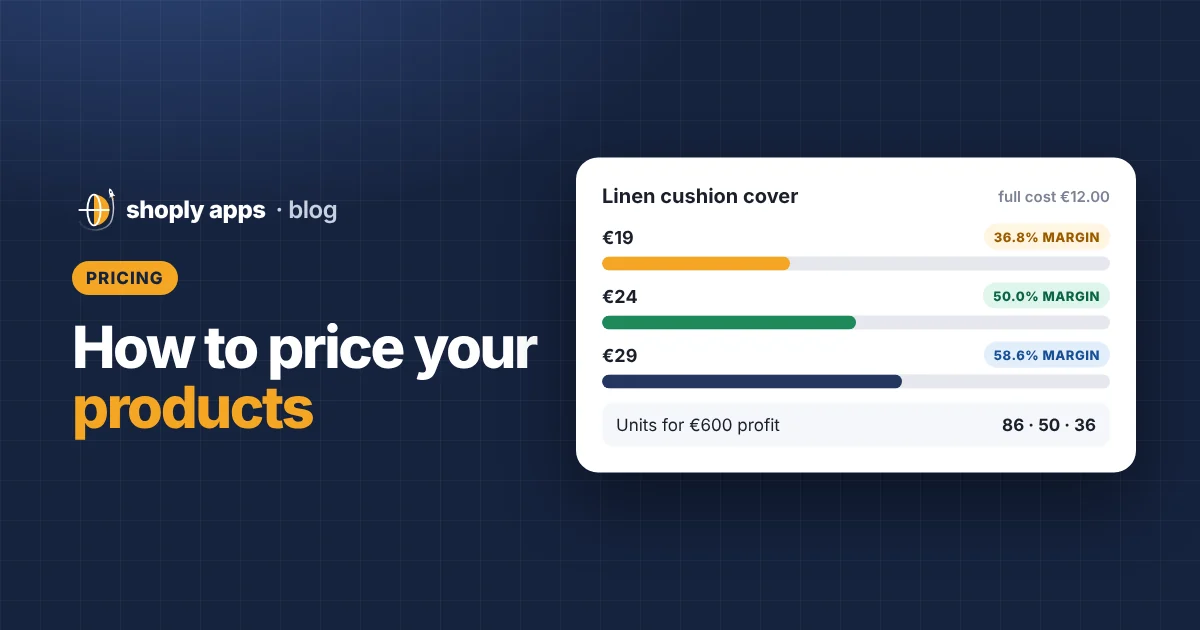
Take the €12 product above and compare a few candidate prices side by side: the margin at each, the profit per unit, and how many units you would need to sell to make the same total profit.
| Price | Profit per unit | Margin | Units for €600 profit |
|---|---|---|---|
| €19 | €7 | 36.8% | about 86 |
| €24 | €12 | 50.0% | 50 |
| €29 | €17 | 58.6% | about 36 |
At €19 you need about 86 sales to earn what 36 sales earn at €29. So the cheaper price only wins if it more than doubles your sales, and it leaves very little room for discounts, ads or a supplier price rise.
Which should you pick? A sensible default is the middle option, €24, then adjust:
- Choose nearer €29 if similar products sell for that much, your photos, brand or service are stronger, or the product solves a real problem.
- Choose nearer €19 only if the market is crowded at that price and you are confident you can sell much higher volumes without extra ad spend.
If you pay for ads to get each sale, that cost also has to fit inside the margin. Our guide to dropshipping profit margins covers ad cost per sale and ROAS (return on ad spend) in detail.
What are the main pricing strategies for ecommerce?
The main strategies are cost-plus, competitor-based, value-based, premium, penetration, psychological pricing, anchoring, bundles and tiers, and building shipping into the price. Most stores combine two or three: cost-plus sets the floor, the others decide where above it you land.
Cost-plus pricing
Set the price from your cost and a target margin. This is the product pricing formula to start with:
Price = Cost ÷ (1 − Target margin)
For a €12 cost and a 50% target: €12 ÷ 0.5 = €24. When to use it: always, as your minimum. Risk: it ignores what customers will pay, so you may leave money on the table or price above the market.
Competitor-based pricing
Look at what similar products sell for and price at, below or above that range on purpose. When to use it: for products shoppers compare easily. Risk: competitors may have lower costs than you, so matching them can mean matching a price that loses you money. Check it against your cost-plus floor.
Value-based pricing
Price on what the product is worth to the customer: the problem it solves, the time it saves or how it makes them feel. When to use it: for unique, handmade or problem-solving products. Risk: you have to show that value clearly on the page, with good product descriptions and photos, or the price just looks high.
Premium or positioning pricing
Price deliberately high to signal quality and position the brand. When to use it: when your product, packaging and service really are better. Risk: everything else has to match the price; a premium price with weak photos or slow delivery hurts trust.
Penetration pricing
Start low to win first customers and reviews, then raise the price. When to use it: rarely, and only with a planned end date and a margin that still covers all costs. Risk: customers anchor on the low price, raising it later can feel like a price hike, and you may attract bargain hunters who leave when it rises.
Psychological or charm pricing
Prices ending in 9 or .99, such as €23.99 instead of €24, are common in retail. When to use it: if it fits your brand; round prices often suit premium stores better. Risk: results vary by audience, so test it on your own store instead of assuming it works.
Anchoring with compare-at prices
Shopify's compare-at price shows a crossed-out "was" price next to the current one. When to use it: for a genuine sale, when the product really sold at the higher price. Risk: invented "was" prices mislead shoppers, and many countries have rules on reference prices, so keep it honest. Also make sure the compare-at price is always higher than the price; an equal or lower one looks broken.
Bundles and tiers
Sell items together (a kit, a set of three) or offer good, better and best versions. When to use it: to raise the average order value or to let customers choose their own price point. Risk: work out the margin on the bundle price, not on each item, and keep the tiers clearly different.
Free shipping built into the price
Add some or all of the shipping cost to the product price so you can offer free shipping. When to use it: when shoppers in your market expect free shipping. Risk: heavy or bulky items can end up priced above competitors. A free shipping threshold is often a safer middle ground.
How much do discounts cut into your profit?
A discount comes straight out of your profit, not out of the price as a whole, so it shrinks profit by a much bigger share than the discount itself. To earn the same profit, you need to sell more units:
Extra sales needed = Margin ÷ (Margin − Discount) − 1
| Margin before discount | 10% off | 20% off | 30% off |
|---|---|---|---|
| 40% | +33.3% | +100% | +300% |
| 50% | +25.0% | +66.7% | +150% |
| 60% | +20.0% | +50.0% | +100% |
Using the €24 example: 20% off makes the price €19.20 and profit €7.20 instead of €12, so you need 12 ÷ 7.20 = 1.67 times as many sales, about 67% more, to stand still. Before running a sale, check that the discounted price still clears your full cost, and plan when the sale ends.
When and how should you raise prices?
Raise prices when your costs go up, when your margin drops below your target, or when demand is strong and you keep selling out. Waiting usually means selling at a thinner margin for months.
- Supplier increases: update cost per item the day you hear about it, then recheck the margin.
- Quarterly review: every three months, recheck product costs, shipping rates and fees against your prices.
- Communicate value: improve photos, descriptions and reviews so the new price feels justified; a small, steady rise is usually easier than one big jump.
This is part of what we are building Shoply: Item Scan & Analytics for. The app, free on the Shopify App Store, flags products selling below cost, at cost or below your target margin, plus odd price gaps between variants, and can raise prices to a target margin in bulk with a preview before anything changes. Read more about the app.
How should you price product variants?
Variant prices should follow the cost and value of each option in a logical order. A larger size that costs you more should not be cheaper than the smaller one, and the steps between sizes should look intentional.
For example (illustrative prices), small €20, medium €22, large €38 looks like a mistake, and so does large €19 when medium is €22. Enter cost per item for every variant, because each one has its own cost, and check the margin on each, not just the first.
Pricing checklist
Run through this before you publish a product, and again at each quarterly review.
- Full cost per unit worked out, including shipping, packaging, fees and returns.
- Cost per item entered for every variant.
- Price meets your target margin: price = cost ÷ (1 − target margin).
- Price checked against similar products in your market.
- Room left for discounts, ads and shipping you pay.
- Compare-at price is real and higher than the price, or empty.
- Variant prices follow a logical order with sensible gaps.
- Discounted prices still above full cost.
- Costs and margins reviewed every quarter.
For a wider monthly routine that also covers stock and product content, use our Shopify catalog health checklist.
FAQ
How do I price products for my Shopify store?
Work out the full cost of one unit, including shipping, packaging, payment fees and a returns allowance. Set a minimum price with price = cost ÷ (1 − target margin), then adjust it against similar products and the value you offer.
What is a good profit margin for an online store?
There is no single right number; it depends on your product, ad costs and how often you discount. Choose a target that still leaves profit after discounts, shipping you pay and ads, and check it against your own numbers.
Is it better to price low to get more sales?
Only if the extra sales make up for the lower profit per unit. In our example, a €12 product needs about 86 sales at €19 to earn the same €600 profit as 36 sales at €29.
Should my prices end in .99?
Charm prices such as €23.99 are common, but results vary by store and audience. Round prices can suit premium brands better, so test both rather than assuming one works.
Check every price against your target margin
Shoply: Item Scan & Analytics, free on the Shopify App Store, flags products below cost, at cost, under your margin target or with odd variant price gaps, and lets you raise prices to a target margin in bulk with a preview and undo.
Install free on Shopify