How to write product descriptions that sell (with examples)
Key takeaways
- To write a product description that sells, start with the buyer: who the product is for, the problem it solves and the questions they would ask a shop assistant.
- Pair every feature with a benefit and a concrete detail, such as size, material or capacity, so the claim is believable.
- A reliable structure is an opening line that names the main benefit, 3 to 5 scannable bullets, the details (size, materials, fit, what's included), care or use, and a pointer to shipping and returns.
- Write your own words instead of copying supplier text, keep the tone consistent across your catalog, and regularly check for products with no description or a very short one.
Learning how to write product descriptions that sell comes down to one habit: write for the buyer, not about the product. A good description answers the questions a shopper would ask in a real shop, in their own words. Below you'll find a simple process, a fill-in-the-blanks Shopify product description template and three before-and-after examples.
This article is about the writing itself. For the fields around it, such as the SEO title, meta description and image alt text, see our Shopify product page SEO checklist.
How to write product descriptions: where do you start?
Start with the buyer. Before you write a word, know who the product is for, what problem it solves for them and what they would want to know before buying.
- Who is it for? A first-time renter and a gift buyer ask different questions. Write to the most likely buyer.
- What problem does it solve? "Keeps coffee hot on a long commute" is a reason to buy. "Premium quality" is not.
- What would they ask in a shop? Will it fit? What is it made of? How do I wash it? What comes in the box? Online, the description has to answer them.
Good sources for these questions are customer emails, reviews and return reasons. If a question keeps coming up, the answer belongs in the description.
What is the difference between features and benefits?
A feature is a fact about the product; a benefit is what that fact does for the buyer. Shoppers buy benefits, but they believe them because of the facts, so the strongest descriptions connect the two and add a specific detail as proof.
| Feature | Benefit | Proof or detail |
|---|---|---|
| Stone-washed linen | Soft from day one and gets softer with every wash | 100% linen, pre-washed before sewing |
| Double-walled stainless steel | Drinks stay cold for hours, with no sweat on your bag | Vacuum-insulated walls, 750 ml capacity |
| Hidden zip | Easy to take off for washing, and looks neat on the sofa | Zip runs along the bottom edge |
| Lightweight gel texture | Sinks in quickly, so you can apply make-up straight after | 50 ml pump bottle, fragrance-free |
A quick test: read each sentence and ask "so what?" If the answer is "nothing", rewrite it.
What is a good Shopify product description template?
A reliable template has five parts: an opening line that names the main benefit, 3 to 5 scannable bullets, the product details, care or use instructions, and a short pointer to shipping and returns. Fill in the blanks, then edit until it sounds natural.
[Product] that [main benefit] for [who it's for].
• [Benefit 1], thanks to [feature]
• [Benefit 2], thanks to [feature]
• [Benefit 3], thanks to [feature]
Details: [size or dimensions], [materials], [fit or capacity], [what's included]
Care or use: [how to clean, store or use it]
Shipping and returns: [one line, plus a link to your policy]
Not every product needs every part: a digital download has no care instructions. Treat the template as a checklist of questions to answer, not a form to fill at any cost.
What do good product description examples look like?
Good product description examples are specific, easy to scan and answer the buyer's questions. Here are three fictional products, each with a weak "before" and an improved "after".
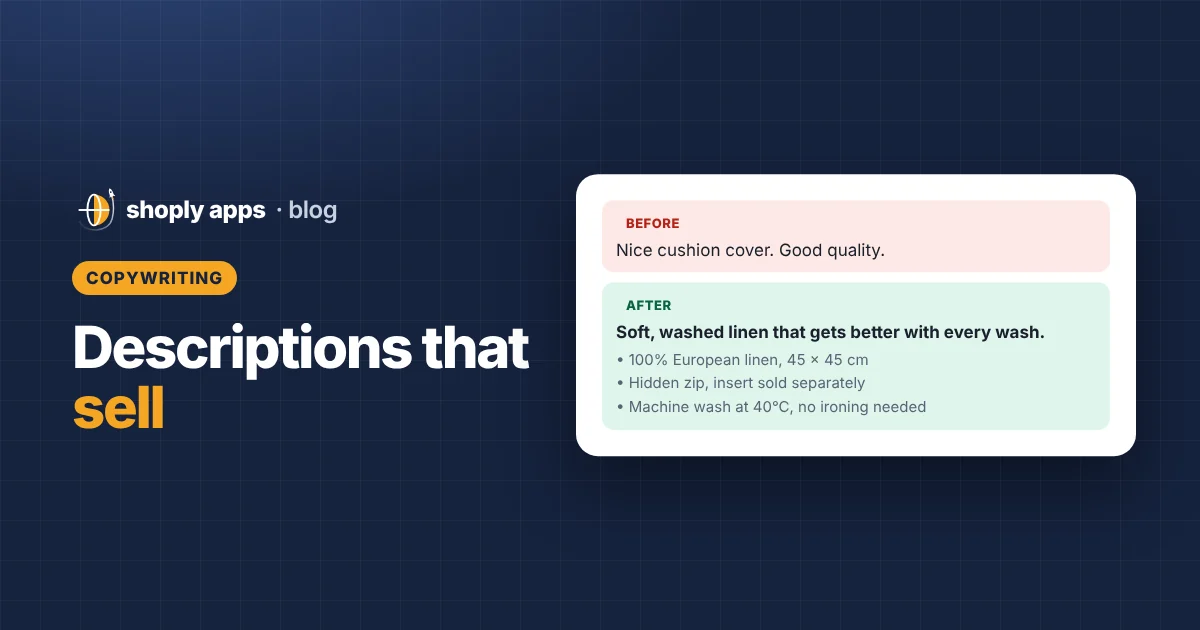
Example 1: linen cushion cover
Before:
Nice cushion cover. Good quality.
Nothing here can be checked. What size? What fabric? Is an insert included? How do you wash it?
After:
A soft, relaxed linen cushion cover that adds texture to a sofa or bed without fuss.
- Soft from day one: stone-washed linen that gets softer with every wash
- Neat finish: hidden zip along the bottom edge
- Easy to mix: available in four muted colours
Details: 45 × 45 cm, 100% linen. Cover only; fits a 45 × 45 cm insert, sold separately.
Care: machine wash at 40°C, line dry. Linen creases naturally; iron while damp for a crisper look.
Free returns within 30 days. See our shipping and returns page for delivery times.
Example 2: stainless steel water bottle
Before:
High quality stainless steel bottle. Perfect for everyday use. Eco friendly.
Anyone can claim "high quality" and "perfect", and "eco friendly" is vague. How big is it? Does it keep drinks cold?
After:
A 750 ml insulated bottle that keeps water cold through a long workday or a weekend hike.
- Stays cold for hours: double-walled, vacuum-insulated stainless steel
- No wet bag: the outside does not sweat with cold drinks
- Fits most cup holders: 7.3 cm wide at the base
- Leak-resistant lid: screw cap with a carry loop
Details: 750 ml, 26 cm tall, weighs 380 g empty. Includes bottle and screw cap.
Care: hand wash only. Not suitable for the dishwasher or freezer.
Ships within 2 working days. Returns accepted on unused items within 30 days.
Example 3: hydrating face gel
Before:
Amazing face gel. Your skin will love it!
Enthusiasm is not information: no texture, scent, size or directions.
After:
A lightweight gel moisturiser for people who dislike the feel of heavy creams.
- Light texture: a clear gel that sinks in quickly, with no sticky finish
- No added fragrance: a faint, clean scent from the ingredients themselves
- Make-up friendly: wait a minute after applying, then follow with make-up as usual
Details: 50 ml pump bottle. Full ingredients list below.
How to use: apply one or two pumps to clean skin morning and evening.
Free returns on unopened products within 30 days.
Notice that the skincare example makes no health claims; it sticks to texture, scent, size and use. Follow the cosmetics labelling and advertising rules in the countries you sell to.
All numbers in these examples are illustrative. Never state a size, capacity or material you have not checked.
How do you keep a consistent tone of voice across your catalog?
Decide a few simple rules once and apply them to every product, so your store sounds like one brand rather than twenty suppliers. Write them in a short style note.
- Voice: warm and plain, or crisp and technical? Pick one that suits your customers.
- Units and spelling: cm or inches, "colour" or "color", and the same order for details every time.
- Banned words: "high quality", "perfect", "amazing" and other words that prove nothing.
Consistency also helps shoppers compare: when every product lists details in the same order, answers are easy to find.
How long should a product description be?
A product description should be long enough to answer the buyer's key questions and no longer. There is no ideal word count: a charger needs less explanation than a mattress. As a rule of thumb, very short descriptions often leave questions unanswered, and those unanswered questions tend to become emails, hesitation or returns.
However long it is, make it easy to scan. Most shoppers skim before they read.
- Keep paragraphs to one to three sentences.
- Use bullets for benefits and details.
- Bold the key facts, such as size, material and what's included, so they stand out.
- Put the most important information first, especially for mobile shoppers.
Text explains what photos cannot, such as weight, feel and care. Our guide to Shopify product photography covers the visual side.
How do you write product descriptions for search engines and AI assistants?
Write for people first, in the words they search with, and search engines and AI assistants get clear, useful text to work with. Keyword stuffing, repeating the same phrase over and over, reads badly and does not help.
- Use customer language. If buyers say "throw pillow cover", include that phrase naturally alongside "cushion cover".
- Be specific. "750 ml, keeps drinks cold for hours" gives search tools something concrete to match. "Great bottle" does not.
- Answer common questions on the page. A short FAQ under the description, such as "Does it fit a 45 cm insert?", helps shoppers and search tools alike.
Should you copy the supplier's product description?
No. Use the supplier's facts, but write the description yourself. Supplier and manufacturer text is usually generic, often appears word for word on many other stores (duplicate content), and was not written for your customers.
This is especially common in dropshipping, where products are imported with the supplier's text attached. If you are setting up that kind of store, our guide on how to start dropshipping on Shopify covers the rest of the setup. Check measurements and materials against a sample if you can.
How do you write product descriptions for a whole catalog?
Use a per-product checklist, work in batches by collection and check the whole catalog regularly for gaps.
A description checklist for every product
- Opening line names the main benefit and who it is for
- 3 to 5 bullets, each a benefit backed by a feature
- Size, materials, fit or capacity, and what's included
- Care or use instructions
- Shipping and returns pointer
- No copied supplier text, no unchecked claims
Batch by collection
Products in the same collection share most of their questions, so write them together. Draft one strong description, then adapt it for the rest.
A worked example, with numbers for illustration only: a store with 120 products in 6 collections averages 20 products per collection. If you rewrite 10 descriptions a day, that is 12 working days, or about two days per collection. Start with your best sellers, where improvements reach the most shoppers.
Check for empty and short descriptions
New imports and old products often end up with no description or just a line. Export your products to CSV and look for blank or very short entries in the description column, then add them to your next batch. Our monthly catalog health checklist includes this check.
We are also building a tool for this. Shoply: Item Scan & Analytics, free on the Shopify App Store, flags products with no description or a short description and includes a description editor with a template, a live checklist and a preview. You can read more in what Shoply: Item Scan & Analytics does.
For other ways to help shoppers decide, see our Shopify conversion rate fixes.
FAQ
How long should a product description be?
Long enough to answer the questions a buyer would ask before paying, and no longer. A simple product may need a short paragraph and a few bullets; a technical or expensive one needs more detail. Very short descriptions often leave key questions about size, material or use unanswered.
Can I use the manufacturer's product description?
You can use the supplier's facts, such as measurements and materials, but rewrite the description in your own words. Supplier text is usually generic, is often used by many other stores selling the same product, and was not written for your customers.
What is the difference between a feature and a benefit?
A feature is a fact about the product, such as double-walled stainless steel. A benefit is what that fact does for the buyer, such as keeping drinks cold through a long day. Good descriptions state both, and back the benefit with a specific detail.
Do product descriptions help SEO?
Yes. A useful, original description gives search engines and AI assistants text that explains what the product is and who it is for. Use the words your customers use, include specific facts and answer common questions, but do not repeat keywords unnaturally.
Find every product with a missing or thin description
Shoply: Item Scan & Analytics, free on the Shopify App Store, scans your catalog for products with no description or a short one, and gives you a description editor with a template, a live checklist and a preview.
Install free on Shopify