Influencer marketing for small Shopify stores: find, pay and measure
Key takeaways
- Smaller creators with a close, engaged audience in your niche often suit small stores better than big accounts, and many accept gifting, small fees or commission.
- Find them through niche hashtags, the accounts your customers follow and your own customers who already post about you.
- Vet each creator on audience fit, real comments, engagement rate ((likes + comments) ÷ followers × 100), content quality, brand safety and signs of fake followers.
- Agree deliverables, dates, usage rights, disclosure and payment in writing; paid or gifted posts usually have to be clearly labelled as ads.
- Give every creator a unique discount code and tracked link, then compare orders and profit with what you paid before rebooking.
Influencer marketing for small business means paying or gifting product to creators so they show your products to their followers. For a small Shopify store, the creators who tend to work best are often not the famous ones but smaller accounts with a close, engaged audience in your niche. This guide covers how to find them, check they are real, agree on payment, and measure whether a post actually made you money.
Why do smaller influencers suit small Shopify stores?
Smaller creators are often more affordable, closer to their audience and more open to gifting or commission deals. You can test several for the price of one large creator.
People usually call these creators "micro influencers" or "nano influencers". There is no official cut-off: "nano" loosely means a few thousand followers, and "micro" means anywhere from several thousand to tens of thousands. What matters more than the label is this:
- Closer audiences. Followers of a smaller account often know the creator, comment regularly and trust their recommendations.
- Tighter niches. A creator who only posts about pottery, trail running or vegan baking reaches exactly the people who buy that kind of product.
- Flexible deals. Many are happy to start with a free product, a small fee or a commission on sales.
How do I find influencers for my store?
Start where your customers already spend time: search your niche hashtags and keywords on the platforms they use, and look at who your existing customers follow and who already posts about products like yours.
- Search hashtags and keywords. Use the terms your customers would use, such as "handmade candles", and note creators whose posts get real conversation.
- Check who your customers follow. See which creators keep appearing among accounts your customers follow.
- Look at who posts similar products. Creators who already review or tag other brands in your category understand the product type and have an audience that buys it.
- Start with your own customers. Someone who already bought from you and posted about it is the easiest partner of all: they like the product and their content is authentic.
Note each one in a spreadsheet with handle, followers, engagement rate and niche. For more on choosing platforms, see our guide to social media marketing for Shopify stores.
How do I check if an influencer is a good fit?
Check five things before you reach out: whether their audience matches your customers, how genuine their engagement is, the quality of their content, whether they are brand safe, and whether their followers look real.
| Check | What to look for | Warning signs |
|---|---|---|
| Audience fit | Followers in the countries you ship to, with interests that match your products | Audience mostly in places you cannot ship to; off-topic content |
| Engagement quality | Real comments with questions and conversation; creator replies | Only emojis or "nice pic" comments; the same accounts commenting on every post |
| Engagement rate | A steady rate across recent posts (see formula below) | Very low rate for the follower count, or wild swings between posts |
| Content quality | Clear photos or videos, a consistent style you would be happy to repost | Blurry content, styles that clash with your brand |
| Brand safety | Tone and past posts you are comfortable being linked to | Offensive content, controversies, many competing sponsored posts |
| Fake followers | Gradual follower growth, followers with real profiles | Sudden follower spikes, many empty or spam-like follower accounts |
How do you calculate engagement rate?
Engagement rate is the share of followers who interact with a post. A simple version:
Engagement rate = (Likes + Comments) ÷ Followers × 100
Example: a creator with 12,000 followers gets 460 likes and 32 comments on a post. (460 + 32) ÷ 12,000 × 100 = 4.1%.
Average this over several recent posts rather than one. There is no single "good" rate, so compare creators of a similar size in your niche.
What should I say when I contact an influencer?
Keep your first message short, personal and specific: show that you know their content, say what you are offering, and make replying easy.
Hi Maya, I run a small candle shop and loved your recent video on setting up a cosy reading corner. I think our cedar and amber candle would fit your style. Would you like one to try, no strings attached? If you enjoy it, I would love to talk about a paid post with your own discount code for your followers. Either way, thanks for the great content. Anna, [store name]
Use the contact they list for business enquiries, often an email in their bio.
How should I pay influencers?
Small stores usually use one of four payment models: free product (gifting), a flat fee, commission on sales (affiliate), or a mix of fee and commission. Which suits you depends on your budget and how much risk you want to share.
| Model | How it works | Pros | Cons |
|---|---|---|---|
| Gifting | You send free product; posting may be optional | Lowest cost; good for testing | No guaranteed post; creators may say no |
| Flat fee | A fixed payment for agreed content | Clear deliverables; creators take it seriously | You pay even if nothing sells |
| Commission / affiliate | A percentage of sales made through their code or link | You only pay for results | Less appealing to creators; needs tracking |
| Hybrid | A smaller fee plus commission | Shares risk; rewards strong sellers | Slightly more admin |
Whatever you pay, work out your margin first so you know how much each order can afford. Our guide to pricing for healthy profit margins shows how.
What should an influencer agreement include?
Even a short email agreement should cover what will be posted, when, how you can reuse it, how it will be disclosed, and how and when the creator gets paid.
- Deliverables: for example one feed post and two stories, or one short video.
- Dates: when the product arrives, when drafts are due (if any) and when content goes live.
- Usage rights: whether you can repost the content on your channels or run it as an ad, and for how long.
- Disclosure: how the partnership will be labelled.
- Payment terms: the amount, commission rate, and when payment is made.
This is general guidance, not legal advice; for larger deals, ask a local adviser.
Do influencers have to disclose paid or gifted posts?
In many countries, yes: paid or gifted partnerships usually must be clearly disclosed so followers know the post is an ad. Examples include FTC guidance in the US and ASA and CMA guidance in the UK.
As a general rule, the label should be clear and easy to see, not hidden among hashtags. Many platforms offer a built-in paid partnership label; check each platform's current rules and the rules where you and your creators are based.
How do I measure influencer sales on Shopify?
Give each creator their own discount code and their own tracked link, then compare sales against what you paid. Without tracking, you cannot tell which creators are worth rebooking.
- Unique discount code per creator. For example MAYA10. Shopify's reports let you see sales by discount code, so you can count orders and revenue per creator.
- UTM links. UTM parameters are tags added to the end of a link (for example
?utm_source=instagram&utm_campaign=maya) so your analytics show where visitors came from, including people who visit but do not use the code.
Worked example: is @maya.makes worth rebooking?
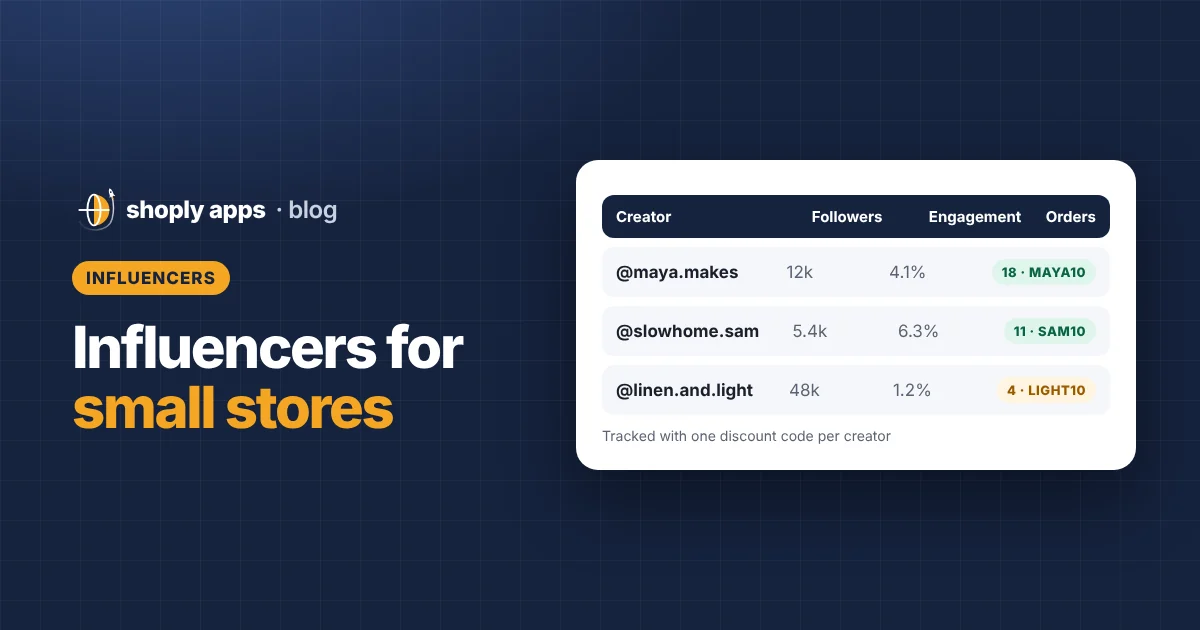
Here is an example with made-up numbers. Creator @maya.makes has 12,000 followers and a 4.1% engagement rate. She posts once, and 18 orders use her code MAYA10 (10% off). All figures below are examples.
- Orders: 18, at an example average order of €40 before discount = €720 revenue
- 10% discount: 18 × €4 = €72, so the store receives €648
- Product costs, at an example cost of €16 per order (40% of €40): 18 × €16 = €288
- Flat fee: €150, plus an example €20 product cost for the gift you sent
Profit = €648 − €288 − €150 − €20 = €190
Cost per order = (€150 + €20) ÷ 18 = €9.44
Including discounts: (€150 + €20 + €72) ÷ 18 = €13.44
This ignores shipping, payment fees and returns, so real profit would be lower.
Put each creator side by side in a simple shortlist. All numbers below are examples:
| Creator (example) | Followers | Engagement | Code | Orders with code | Paid | Cost per order |
|---|---|---|---|---|---|---|
| @maya.makes | 12,000 | 4.1% | MAYA10 | 18 | €150 + gift | €9.44 |
| @slowhome.sam | 5,400 | 6.3% | SAM10 | 11 | €80 + gift | €9.09 |
| @linen.and.light | 48,000 | 1.2% | LIGHT10 | 4 | €300 + gift | €80.00 |
Cost per order here is fee plus the €20 gift, divided by orders. The account with four times Maya's followers produced the fewest orders at by far the highest cost per order, while the smallest account sold at a similar cost per order to Maya, which is why follower count alone is a poor guide.
How do I scale influencer marketing once it works?
Rebook the creators who sold, reuse their best content as ads, and turn the strongest partners into long-term ambassadors.
- Rebook what works. One post is a small test; repeat posts often perform differently as followers see the product again.
- Ask for usage rights. Creator content can make strong ads and product page content. Agree in writing how long you can use it. Our Instagram selling guide and TikTok marketing guide cover how to post and promote it.
- Build ambassador relationships. Offer your best creators an ongoing commission, early access to new products or a regular monthly fee.
What are the most common influencer marketing mistakes?
The biggest mistakes are choosing creators by follower count alone, not tracking sales, skipping the brief, and running out of stock just as the post goes live.
- Judging by followers alone. Engagement and audience fit matter more.
- No tracking. Without a code or link per creator, you cannot tell who sold and who did not.
- No brief. Share the key product points, what to avoid saying, the disclosure, the code and the dates.
- Products out of stock when the post goes live. A post that sends buyers to a sold-out page wastes your fee. Check stock before every launch; our guide to out of stock and oversold products explains how. Shoply: Item Scan & Analytics, free on the Shopify App Store, flags low-stock items and products likely to sell out soon so you can restock before a campaign.
FAQ
How many followers does a micro influencer have?
There is no official number. People loosely use "nano" for accounts with a few thousand followers and "micro" for accounts with several thousand to tens of thousands. Engagement and audience fit matter more than the exact count.
How much should a small store pay an influencer?
There is no standard rate. Many small stores start with gifting or commission, then pay a flat fee to creators who have proven they sell. Work out your margin first so you know what each order can afford.
How do I know if an influencer post made sales?
Give each creator a unique discount code and a link with UTM tags. Shopify reports sales by discount code, so you can count orders and revenue per creator and compare them with what you paid.
Do I need a contract with an influencer?
A written agreement, even a short email, is wise. Cover deliverables, dates, usage rights, disclosure and payment terms. This is general guidance, not legal advice; ask a local adviser for larger deals.
Make sure your products are ready before the post goes live
Shoply: Item Scan & Analytics, free on the Shopify App Store, scans every product for stock, margin and content problems, so you can catch low stock, thin margins and weak product pages before a creator sends traffic your way.
Install free on Shopify